


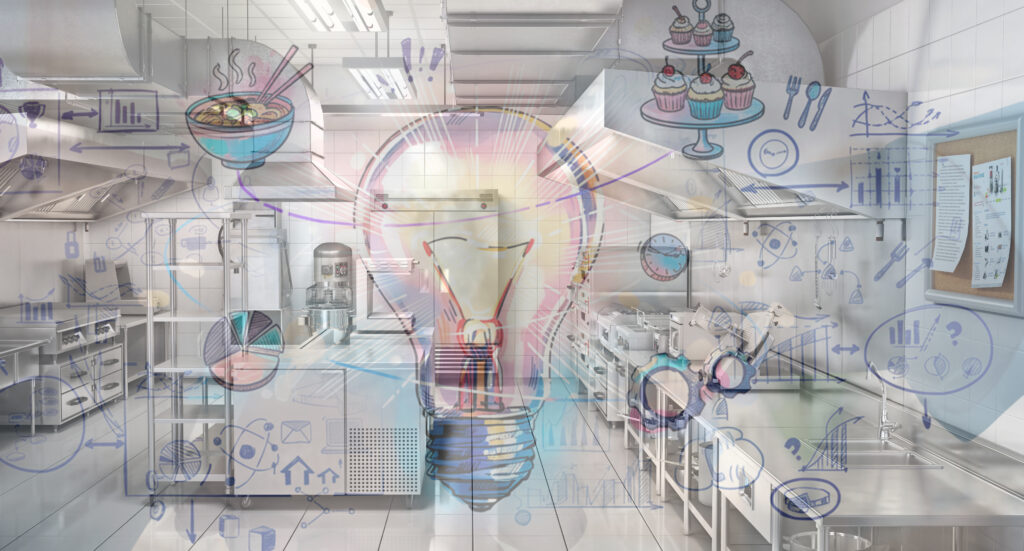
Talking about innovation in collective catering today necessarily means broadening our perspective. The sector is facing structural challenges that can no longer be addressed with isolated solutions. Real innovation is based on the balance between gastronomy, technology and digitalisation—three dimensions that only work when they move forward in a coordinated way.
Innovation has become a strategic issue for collective catering. In a context marked by cost pressure, a shortage of qualified staff, increasing nutritional and regulatory requirements and an increasingly diverse diner profile, the sector needs more than incremental improvements. Today, innovation means rethinking the model from a global perspective, supported by three mutually reinforcing pillars: gastronomy, technology and digitalisation.
The starting point remains gastronomy, but understood from a much broader perspective than purely creative approaches. For years, many collective kitchens have worked with a limited range of solutions, simplifying ingredients and techniques to reduce risks, especially in areas such as allergen management. This has led, in many cases, to a loss of variety and appeal in menus. Today, gastronomic and food innovation, supported by new ingredients and technical solutions, makes it possible to recover variety and quality without compromising safety.
From a strategic sector perspective, Xavier Beltrán, from Agar, Asesoría de Gestión Alimentaria, points precisely to the need to change this logic; “at Agar, we work under a comprehensive vision of kitchen management, gastronomy and nutrition, translating this into standardisation processes, tasks, work routines, training and support during implementation”. For Beltrán, the challenge lies not only in the final product, but in understanding the process as a whole and overcoming an overly basic view of collective kitchens: “it is about aligning gastronomic and nutritional acceptance with the operational reality. True innovation lies in applying a system capable of integrating these two aspects within the profitability and sustainability parameters that the sector requires”.
This approach connects directly with the second pillar: technology applied to the kitchen. In a sector with high staff turnover and a shortage of qualified profiles, technology has become a key tool for ensuring consistency, efficiency and control. However, its adoption is not always straightforward. As Julián Pizzi, National Corporate Chef at Rational, explains, “the shortage of qualified staff and high turnover do not favour adaptation to technology, not to mention that in some cases there is a certain resistance to change and to investing in technological innovations in the kitchen. Very often, familiar processes are prioritised, using pots, boiling pans, frying pans… it also happens that operational staff often do not have the necessary decision-making power, which limits the adoption of more up-to-date solutions”.

In the face of this resistance, well-applied technology provides very concrete solutions. “Rational cooking systems, for example, reduce dependence on highly qualified staff and simplify daily operations, as they make it possible to establish intelligent cooking processes that are easily replicated and always guarantee the same result,” notes Pizzi. In addition, the incorporation of digital tools associated with the equipment facilitates control of aspects such as food safety, HACCP or energy consumption, also contributing to cost reduction. By combining just a couple of units such as Rational’s iCombi Pro and iVario Pro, it is possible to prepare virtually any recipe required in a collective kitchen in a faster, healthier and more controlled way thanks to technology.
From the equipment field, but with a clearly gastronomic outlook, Francesc González, Chef Product Manager at Cotesa – Alotex, advocates precisely this integration between kitchen and technology. Trained as a chef, González insists that “gastronomy must be combined with technology and technique” in order to respond to increasingly complex challenges. In his view, “cooking techniques can facilitate a greater variety of diets”, provided that the equipment is designed based on real knowledge of the kitchen and its operational needs.
The third pillar of innovation is digitalisation, the element that makes it possible to connect the entire system and finally leave behind the ‘paper chaos’. Without digital management of processes, it is very difficult to optimise resources, control costs or react quickly to deviations. As many sector operators point out, ‘without data there is no control, and without control there is no sustainable innovation’.
In this area, solutions such as those provided by Delsys by SEIDOR and FSMax Systems make it possible to move towards comprehensive management covering everything from menu and purchasing planning to production, traceability and the analysis of key indicators. Digitalisation ceases to be an additional layer and becomes the true brain of the collective catering model.

As Jordi Pairó, Commercial Director at Delsys by SEIDOR, explains, “collective catering faces particularly demanding digitalisation. We are talking about environments with high production volumes, very strict regulations and intense day-to-day operations, where time, costs and simplicity are critical factors. There is no room for error here. Food safety, consumer health and legal compliance are at stake. One of the main challenges is leaving behind the manual and fragmented management of key processes such as production, quality control or traceability. Many centres still rely on paper, spreadsheets or unconnected systems. At SEIDOR, we believe that digitalisation must adapt to the operational reality of kitchens, not the other way around. That is why we develop solutions that optimise daily activity without creating additional workload for teams. Thanks to our experience with technologies such as SAP, we can offer a more comprehensive approach. Digitalisation is not limited to what happens in the kitchen, but connects with areas such as purchasing, finance, documentation or analytics. This makes it possible to evolve towards more integrated, scalable and sustainable management models, prepared to grow with the business”.
Specialised solutions such as those offered by Delsys by SEIDOR make it possible to manage the entire operational cycle: from defining menus and diets to production planning, purchasing, the reception of raw materials, packaging control and dispatch. These tools allow organisations to be supported not only in their current operations, but also in their processes of growth, diversification or digital transformation in the medium and long term, accompanying the business in its future evolution.

From FSMax Systems, they confirm that the key to this type of tool is integrated automatic management, “global control through a single tool”; beyond this, Ana Belén Ramírez, Senior Consultant at FSMax Systems, introduces another key idea by stating that “the ultimate objective of this entire system is the end consumer, who receives the result of what is produced in collective kitchens and who, through their experience and interaction with the service, provides key information for evaluation. Therefore, without losing sight of the overall process, at FSMax we advocate giving greater weight to the user’s voice, integrating their needs, preferences and real behaviour into management systems”. FSMax’s solutions include applications for clinical and nutritional assessment, menu selection, tools for controlling the quality of the food that reaches the end user, and systems for measuring plate waste, providing objective data on acceptance, satisfaction and nutritional adequacy. “This information makes it possible to anticipate tastes, detect deviations and correct those aspects where the expected level of service is not being achieved, strengthening collective catering models that are more efficient, healthier and more people-oriented,” comments Ramírez.
Closing the circle
The key, ultimately, lies in working jointly with innovation in gastronomy/food, technology and digitalisation. As Francesc González summarises, “these three aspects must be brought together in order to gain a new overall perspective of the entire process, fostering collaboration between gastronomy, dietetics, kitchen operations, technology and management. Only in this way is it possible to build more efficient, healthier models adapted to the new demands of the sector”. Finally, Xavier Beltrán insists that “the lack of standardisation is a key factor that greatly hinders the control and management of collective catering services. In this sense, the digitalisation of work systems that can ensure consistency, homogeneity and control makes the difference towards more efficient management. At Agar, we support processes with digital tools so that changes are consistent and innovation becomes synonymous with efficiency”. Technology makes it possible to close the circle between planning, production and consumption.
This comprehensive vision is also what shapes the ‘Restauración colectiva: meeting point’ space at Alimentaria + Hostelco, a meeting place where products, equipment, consultancy and digital solutions align to show how innovation is no longer a promise of the future, but an essential reality for today’s collective catering sector. Of course, all the companies mentioned can be found exhibiting in this collective catering space.
By Ana Turón, journalist at Restauración Colectiva