


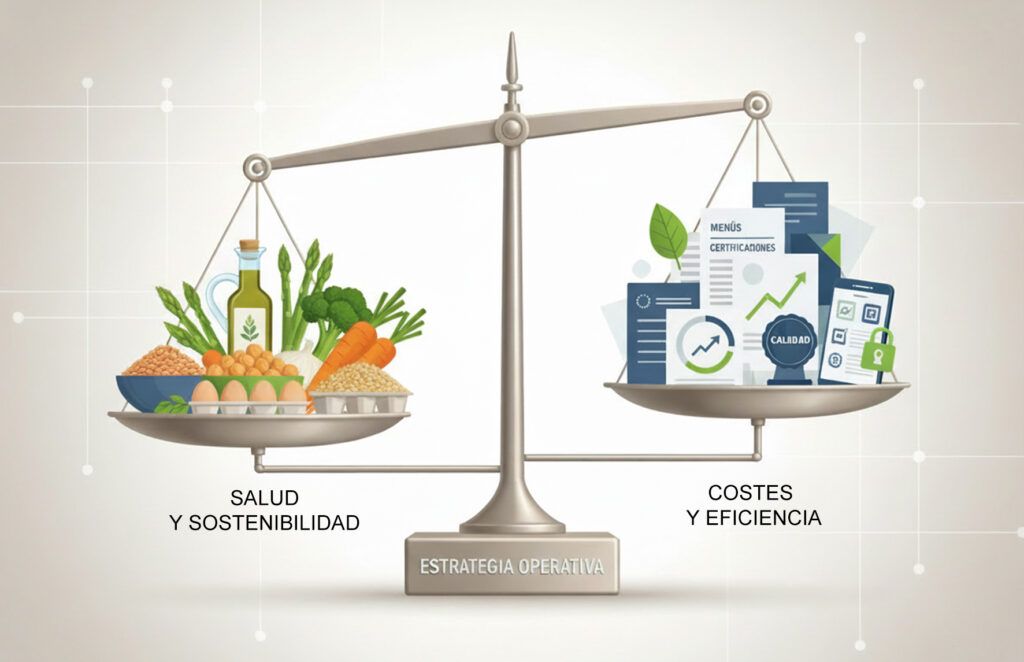
In contract catering, purchasing is no longer just about choosing products at the best price: it is a strategic decision that defines the health, sustainability and efficiency of thousands of meals every day. From product reformulation and nutritional adaptation to the incorporation of new functional and organic categories, or the digitalisation of procurement processes, the purchasing system has become one of the main drivers of transformation in the sector. Today, what is purchased — and how it is purchased — directly impacts the diner’s experience and the sustainability of the model.
For years, purchasing in contract catering was mainly associated with criteria of price, volume and security of supply. However, the current context — marked by greater nutritional requirements, sustainability objectives and pressure on operational efficiency — has radically changed this approach.
As Bruno Cesena, Purchasing and Logistics Director at Serunion, points out, “buying well is not only about guaranteeing supply and price, it is about decisively influencing the nutritional quality of menus, their environmental impact and the operational viability of the service”.
In large-scale operators, this vision requires balancing standardisation and flexibility. Purchasing must guarantee food safety and consistency, but also adapt to very different realities: hospitals, schools, care homes or corporate canteens. At this point, framework agreements, approved catalogues and the incorporation of regional suppliers become key tools for responding to this complexity. As Cesena adds, “an operator such as Serunion needs standardisation, but we cannot be rigid. We work to maintain common criteria without giving up the flexibility needed to respond to the different realities of the business. For this reason, we place special importance on the design of framework agreements that allow local adjustments and on the incorporation of regional suppliers who bring value, knowledge of the environment and the ability to adapt to each client. Balance is achieved by clearly defining the common ‘what’ and ‘how’, and leaving room to adjust the ‘for whom’ according to each business line and the specific needs of each end client”.
The role of suppliers today is absolutely relevant, moving beyond being mere providers to becoming strategic partners… “they are a fundamental pillar — adds Bruno Cesena — to the point of being essential, for example, in achieving certifications”.
This evolution is also reflected in how some major suppliers are redefining their role in contract catering. From Danone, Vicenç Guevara, National Key Account Manager at Danone Iberia, notes that “the purchasing decision in categories such as dairy, waters or plant-based alternatives has ceased to be a purely operational matter and has become a direct lever for health and wellbeing for thousands of diners every day”.
In a context marked by higher nutritional requirements, rising allergies and intolerances and more dynamic consumption habits, the focus is shifting towards more balanced, inclusive portfolios adapted to the real operations of schools, hospitals or care homes; “a scenario in which collaboration and co-creation with operators is key to translating nutritional objectives into viable day-to-day solutions. For example, in schools we support with proposals with less added sugar using children’s licences to encourage healthy choices. In hospitals and care homes, we support with products that provide essential ingredients to guarantee good daily nutrition,” concludes Guevara.
The evolution of purchasing systems: digitalisation, efficiency and support
The transformation of purchasing affects not only what is bought, but also how the entire process is managed. Digitalisation has opened the door to more informed, comparable decisions that are better aligned with the reality of each centre.
From this perspective, platforms such as Save Up Market exemplify how technology can help professionalise decision-making. Their proposal is based on offering verified information according to similar types of centres, making it easier for organisations to identify solutions already validated in the sector. As Marc Ferré, the firm’s Managing Director, explains, “when you search for information, our platform suggests solutions that other operators are using to respond to needs similar to yours”.
Digitalisation also directly impacts operational efficiency: order planning, forecasting needs according to menus, stock reduction and less waste. In Ferré’s own words, it is about adjusting orders “to the kitchen’s real needs”, avoiding unnecessary accumulation and improving procurement control. “The transformation of purchasing in catering services is moving towards an increasingly gastronomic form of catering, focused on the product and the final user or diner experience. The aim is to provide products of the highest value, which raise the standard of their experience and always respond to the nutritional needs demanded by the sector, both in the social-health field and in school catering,” concludes Marc Ferré.
In parallel, other distribution company models have evolved towards a more consultative role. This is the case of Central Borne, which has moved from being a product supplier to offering comprehensive solutions linked to kitchen management and menu planning.
As Artur Arqués, CEO of the firm, summarises, “we have evolved from being product suppliers to being providers of solutions and management information support to optimise our clients’ productivity”. This support makes it possible to align product selection with the profile of the end user and with the productive capacities of each kitchen, reinforcing the idea that purchasing is a strategic tool serving the system as a whole.
New regulatory framework, new requirements
Added to this vision of purchasing as a planning and optimisation tool is, with increasing weight, the impact of the regulatory framework. New requirements regarding healthy menus are accelerating profound changes in procurement decisions, forcing operators to seek references that allow them to simultaneously meet nutritional, environmental and operational criteria without adding management complexity.
In this context, the emergence of new organic and functional product categories becomes a key element. As Ramon Pons, Director of Good Bio Foods, points out, “the new categories allow operators to comply at the same time with health regulations, social demand and operational viability”.
The entry into force of new royal decrees on healthy menus such as Royal Decree 315/2025 on school canteens, with stricter limits on added sugars and greater requirements for organic and seasonal products, has transformed what was previously a differentiating option into a regulatory requirement. According to Pons, operators are no longer seeking only healthy ingredients, but proposals that reduce the complexity of the purchasing system and minimise risks of non-compliance: references that integrate attributes such as organic certification, absence of added sugar, proximity and adaptation to different nutritional needs. “Sustainability has ceased to be a marketing claim and has become an audit criterion and a reputational factor for families,” notes Pons.
From the perspective of strategic purchasing, these types of solutions provide a key added value: predictability. In an increasingly demanding regulatory environment, having suppliers who anticipate regulatory requirements and integrate them into their catalogue facilitates decision-making, reduces internal friction and allows operators to focus on service quality and the diner experience.
Purchasing seen from daily operations: scale and proximity
If in large operators complexity is driven by scale, in smaller projects the key lies in proximity and flexibility. At Ecomenja, for example, purchasing is conceived as a direct extension of the food model they advocate: organic products, local sourcing and stable agreements with producers.
As Joan Maria Ribas, Head of Operations, explains, the purchasing criteria in our organisation are based on “proximity of the production area, consumption planning and stable price agreements with producers”.
This is complemented by a strong commitment to production systems without synthetic chemical products, with a high percentage of organic produce. For Maria Cervelló, Manager of Ecomenja, collaborative work with suppliers is key to maintaining this model: “networked work with producers and suppliers allows innovation, without losing agility, in aspects as critical as being able to provide a very high percentage of organic and locally sourced products in our diners’ dishes, a powerful argument in terms of health, sustainability and efficiency (win-win)”.
A shared meeting point
Beyond differences in scale and approach, all voices agree on one essential point: purchasing decisions are today one of the most powerful levers for transforming contract catering. From digitalisation and efficiency, to product reformulation, nutritional planning or proximity to the territory, buying well has become a way of taking better care of people and building more sustainable food systems.
All these reflections will find their place in the contract catering area (Contract Catering: Meeting Point) of Alimentaria + Hostelco, the meeting point where suppliers and operators share experiences, solutions and visions for the future. A space that will also host the VII Contract Catering Congress, consolidating itself as an essential event for understanding where a sector is heading in which purchasing has become a genuine lever for transformation.