


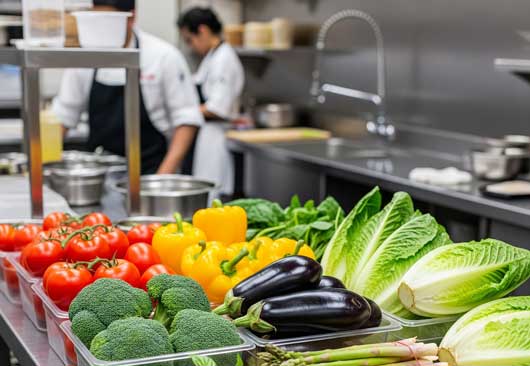
Spain is one of the world’s leading organic food producers and is at the forefront of Europe in terms of organic agricultural land. However, domestic consumption of these products is growing at a moderate pace and remains largely household-based. In the horeca channel, there is still a great deal to be done, although the potential is enormous…
This is confirmed by the latest data from the Spanish Ministry of Agriculture, Fisheries and Food MAPA: Spain has consolidated its position as the leading producer in the European Union (EU) in terms of organic production area, with almost three million hectares, and ranks sixth worldwide. In 2024, the percentage of utilised agricultural land dedicated to organic production grew by 2.33% compared to the previous year.
And there is more: organic production has reached a record level of exports, with a trade surplus of €3.102 billion in 2024, further consolidating Spain’s European leadership.
Do we truly value organic products in Spain? The National Food Strategy highlights the importance of boosting this sector as a key commitment to preserving biodiversity and protecting the environment within the national agricultural framework.

Let’s talk about consumption: Spanish consumers’ spending on organic products reached €2.89 billion in 2024, a slight decrease of 0.89% compared to 2023, according to MAPA data. Per capita spending stood at €59.44, with 94.2% of consumption taking place at home, showing that organic food consumption in Spain remains predominantly domestic. Organic products accounted for 3.2% of total food expenditure.
What are the forecasts looking ahead to 2026? Everything suggests that organic consumption in Spain will continue to grow, but at a moderate pace, still far behind figures seen in other European countries, and affected by inflation and global instability. Nevertheless, there is no doubt that growing concern for health and the environment is driving organic food consumption, although price remains a barrier for many consumers.
Organic food in the Hospitality Sector
If organic food already faces challenges in household consumption, the situation becomes even more complex in the horeca channel.
In institutional catering, progress is somewhat greater due to new nutritional regulations, such as the royal decree approved in April requiring schools to ensure that almost half of the ingredients in their menus are local or seasonal, in addition to including a minimum of 5% organic products. This will entail a significant redesign of supply chains and higher costs in a context of already very tight budgets.
In hospitality, chains such as Veritas are contributing to the sector’s growth. The professional division of the Catalan organic supermarket chain launched a few months ago its online store of organic products aimed specifically at small and medium-sized hospitality businesses, offering capillary logistics services across mainland Spain and the Balearic Islands. With nearly 3,000 certified organic references, Veritas Food Service surpassed €6 million in turnover in 2025, representing growth of 15%.
Anselmo Méndez, the company’s managing director, is optimistic about the current state of the sector: “The growth of the organic market in Spain is maintaining an annual double-digit rate, driven by consumer demand and by public procurement policies for organic food, which set mandatory minimums for seasonal products and organic spending in school and hospital canteens. This trend foresees an increase from 30% to 60% in the volume of organic products served in institutional catering over the next two years, a scenario that positions Veritas Food Service as a key player in the transition towards healthier and more sustainable food.”
Restaurants committed to organic produce
In Spain, an increasing number of restaurants and accommodation providers are making a firm commitment to sustainability and, within that, specifically to organic food.
This is the case of Jordi Vilà, from the Barcelona-based restaurant Alkimia, holder of a Michelin star, a perfect example of a chef who clearly champions organic produce and explains that it plays “a core role” in his business. “We don’t state it explicitly, just as we don’t state many other things, that a restaurant like Alkimia is a restaurant of excellence, and that directly connects us with the organic world,” he explains. “What we do is seek out the very best product in order to create the best possible cuisine. That usually means working with small producers and ensuring that they operate in the best possible way, that is, through organic production or, in some cases, biodynamic production.”
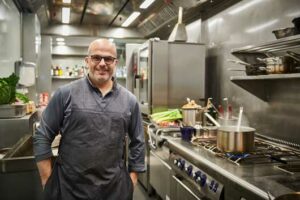
The chef explains that Alkimia works with between 70 and 80 different producers, “who often supply wild products, sometimes organic products, and at other times it is not possible due to the characteristics of certain foods. But we always prioritise it.”
What would Jordi Vilà ask of the organic food sector in order to receive better service? The chef responds: “It is a challenge for everyone, especially when we want to optimise the offer and make it more organic. What we ask of them is simply not to give up; that is enough for us, because we are aware of the difficulties and competition in the market. With that, we are satisfied.”
Organic catering: uneven progress
Oriol Urrutia, co-editor of the specialist magazine Bio Eco Actual, explains that when it comes to organic food, Spanish catering is moving forward, “but it is still doing so unevenly.” “There is a growing group of restaurants, especially in independent catering, institutional catering and concepts linked to health and sustainability, that already integrate organic products in a structured way,” he notes. “However, overall, Spain lags behind countries such as France, Germany or the Nordic countries, where the use of organic food in horeca is more normalised and, in many cases, driven by public policies and institutional purchasing.”
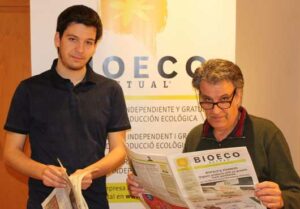
Price is one of the factors holding back organic food consumption in the horeca channel, but for Oriol Urrutia it is neither the only nor necessarily the main factor. “From our experience, the main barriers tend to be a lack of knowledge about organic products and their certification; the lack of adaptation of formats and logistics to the real needs of the horeca channel (something the sector urgently needs to address); operational inertia; the difficulty of changing established suppliers; and the perception that the end consumer does not value or understand it.”
Regarding this last point, certification initiatives and the visibility of restaurateurs’ actions “are very important,” he explains. “When professionals are well acquainted with the product, adjust their purchasing and communicate it properly, organic food can be integrated with reasonable margins and can provide differentiation, reputation and coherence to a gastronomic project.”
Organic products with potential in horeca
When considering organic food, many hospitality professionals typically think of fresh produce, fruit and vegetables, although there are many other organic products yet to be explored in the horeca channel.
Bio Eco Actual sees strong potential in categories such as pulses, rice, pasta and flours. As for beverages, wines stand out in particular “but increasingly also beers and soft drinks.” Specifically, kombucha is highlighted as a “flagship” category, which has already grown with leading brands committing to organic production, as well as plant-based alternatives adapted for catering, “although in the latter case there is a risk of confusion and greenwashing, with brands giving their products a ‘green’ image without being certified”, explains Oriol Urrutia.
Meanwhile, products such as oils, sauces, preserves and condiments—key to elevating culinary proposals—also show strong potential. “Many of these categories will be present at Alimentaria and represent a clear opportunity for diversification and added value for the horeca channel.”
Organic products at Alimentaria 2026
Specifically, Alimentaria 2026 will be a key event for the organic sector, featuring a dedicated space, Organic Foods, located in Hall 5 of the exhibition venue.
Certified organic products will also be present in other areas of the fair (Interlact, Grocery, Lands of Spain…), clearly identified with the Euro-leaf, the sector’s common label. In addition, La Plaza Eco will debut for the first time: a new space dedicated exclusively to organic producers, featuring activities, talks, product presentations and networking.
Everything can be easily followed through the online and printed guide aimed at industry professionals, “The Organic Route of Alimentaria 2026”, which Bio Eco Actual will distribute at the fair.
In the exhibition area, there will be no shortage of organic products for the horeca channel, such as those from Gourmet Eco Foods. For this company, the horeca channel “is key and has very significant strategic weight within our expansion plan,” says managing director Lluc Sosa Barth. “Alimentaria is precisely a fundamental meeting point that allows us to engage directly with distributors, restaurateurs and chefs who are leading the shift towards more conscious and sustainable catering.”
For Lluc Sosa, growth opportunities are very solid “The horeca channel is evolving towards more sustainable proposals, with organic, traceable and high-quality products—an area in which we have extensive experience and a very well-established portfolio.”
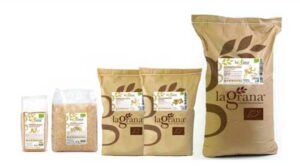
The director of Gourmet Eco Foods explains that the products currently performing best in the horeca channel are staples such as rice or quinoa, “always with organic certification. We offer solutions that are easily applicable in catering, backed by recognised certifications such as organic certification and gluten-free certification.”
At Alimentaria 2026, the company will present new launches that address needs not yet covered within the gluten-free food category: new gluten-free baked goods (such as bread and muffins), as well as fresh gluten-free pasta, wraps and flatbreads.
Another company with a specific organic offer for horeca at Alimentaria will be Europea del Pistacho, with 70% of its range dedicated to this channel, having specialised in making pistachio easier to work with for chefs and pastry professionals. The company sees growth potential in hospitality, “as pistachio is gaining significant prominence in the kitchen.”
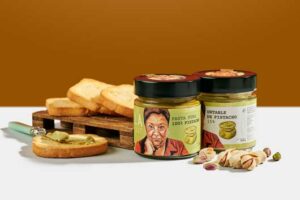
The company offers the catering sector pistachio products adapted in all formats: pure pistachio paste and spreadable cream (in 200 g, 1 kg and 5 kg formats), as well as flour, granules and shelled pistachios (in 200 g, 500 g, 1 kg, 5 kg and big bag formats). At Alimentaria it will present new products such as roasted pure pistachio paste, caramelised pistachios and chocolate-coated pistachios.
A Sector with Strong Potential
Organic food will not be absent (nor should it be) from an event such as Alimentaria, as it is already a first-rate productive, economic and social reality. “That the country’s leading food trade fair incorporates, highlights and organises this offer is consistent with market reality,” says Oriol Urrutia. “Moreover, Alimentaria is the space where the industry observes itself. If we want to move towards a healthier, more competitive food model aligned with regulatory requirements and consumer demand, the organic sector must be present across the board. The decision to identify organic products in all areas of the fair, and not just in a specific zone, is a very important step in this direction.”
There is still much to be done in Spain, “but the good news is that the potential is enormous: in terms of gastronomic culture, product quality and productive capacity,” he concludes. “Above all, what is missing is a fluid connection between supply and professional demand, something that platforms such as Alimentaria help to accelerate.”
By Marta Renovales, journalist at Profesionalhoreca.com